

The Impact of Hybrid Work Models on Architecture Firm Hiring
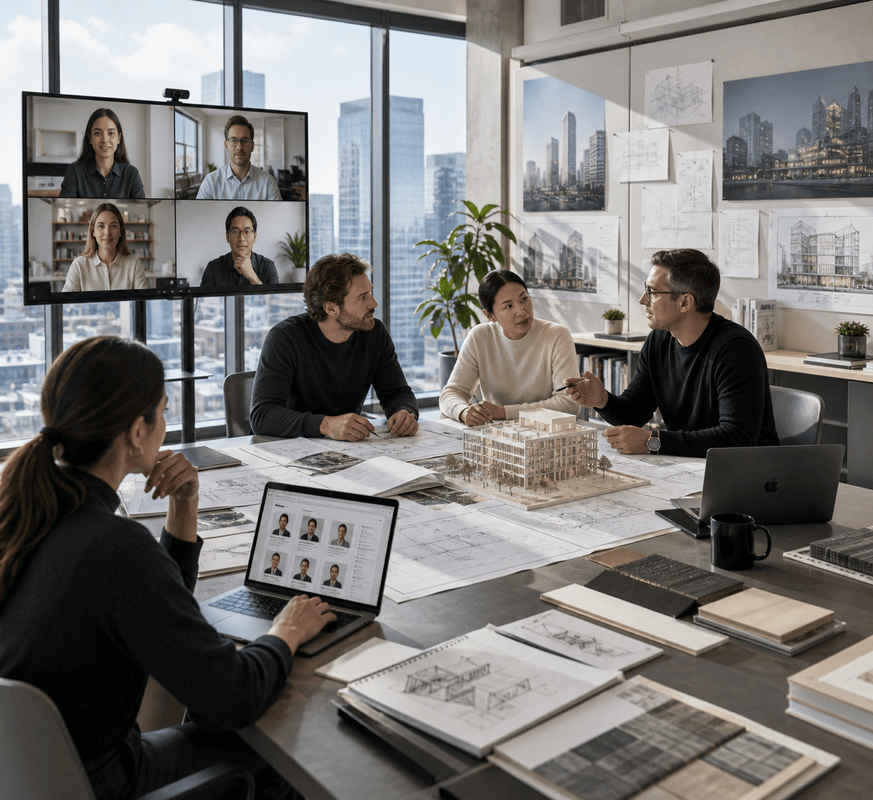
Hybrid work in architecture firms may have started as a response to the pandemic, but it seems to be here to stay. According to a survey by Bespoke Careers, 90% of architecture firms offer some kind of hybrid work. The main motivation for this is to provide employees with more workplace flexibility, but there are other benefits to having a hybrid workforce in architecture. In a survey from Autodesk, 31% of AEC leaders say their firm’s digital transformation has improved productivity, and hybrid work is part of that equation.
The offer of hybrid work is also one of the top architecture firm hiring trends in recent years. When offered the choice between on-site, remote, or hybrid work arrangements, over half of architecture professionals marked hybrid as their top preference in a survey by Archinect. This reinforces the idea that offering hybrid work is among the top architecture recruitment strategies in 2026, particularly for smaller firms that may struggle to keep their talent pipeline full.
The bottom line here is that hybrid work is fundamentally changing the ways businesses today attract and retain architecture talent. While there are inherent challenges of hybrid work in architecture firms, it is also a trend that offers significant benefits for those organizations that are prepared and equipped to embrace it.
The shift to hybrid work in the architecture industry
Before 2020, the strong emphasis on in-person collaboration, as well as physical models and drawings, led to the assumption that remote work in the architecture industry wasn’t feasible. Instead, work environments were designed around shared in-person space, whether in the office or during physical site visits, and on-site file servers and workstations provided the tools and information required for core tasks. Even though BIM and cloud-based tools existed, most were still hosted locally, which made real-time collaboration from different locations difficult. Working remotely was possible, but it was not the norm and was usually reserved for senior staff or individuals who needed special accommodations.
This landscape changed in 2020 when lockdowns forced offices and job sites to close. Firms were forced to use distributed design teams if they wanted to keep work going, and quickly adopted tools like video conferencing and remote BIM workflows. While many were unprepared to make this shift, and there were plenty of early challenges with project coordination and maintaining the architecture firm culture in remote teams, companies learned how to make things work.
As restrictions eased, hybrid work emerged as a practical compromise between the old on-site only approach and the flexibility professionals get from working remotely. The simple truth is that many AEC roles cannot be done entirely remotely. Architecture involves physical spaces, site visits, and regular coordination with engineers and contractors, which cannot always be handled from behind a screen. Combined with the need for iterative feedback loops and collaborative design processes, plus the fact that many firms rely on legacy workflows and on-premise servers, some in-office time is often necessary. But the rise of BIM tools expands which tasks can be done from anywhere, and makes a hybrid work policy in architecture firms an appealing way to help employees maintain their work-life balance without sacrificing productivity and design quality.
The remote work experiment of 2020-2021 also shifted employee expectations in the architecture industry. Professionals saw first-hand which tasks they could do just as well remotely and which were best done in a shared physical space. Increasingly, architecture firm workplace flexibility has become a deciding factor for professionals seeking a new role, and hybrid is overwhelmingly the preferred model. In the Bespoke Careers survey cited in the introduction, 91% of professionals said they prefer at least one day per week working remotely, with 3 days in the office and 2 days working from home the most commonly preferred arrangement.
How hybrid work affects architecture hiring
Hybrid work is more than an architecture staffing trend. For firms hiring architects in 2026, it’s become a competitive advantage. Giving employees the option to work from home, even part of the week, can make a noticeable difference in how candidates view a firm. Firms with hybrid policies are often viewed as more forward-looking and tech-savvy. It signals both that you’ve invested in digital tools that make architects’ lives easier, and that you are committed to providing a positive employee experience. In a crowded and competitive employment market, that signal can be a powerful brand differentiator.
Generally, hybrid work is perceived as reducing burnout risk and promoting a higher quality of life for employees, and the data backs this up. A study conducted by the International Workplace Group found that 75% of the over 1,000 workers in the study reported a significant reduction in burnout symptoms after moving to a hybrid model. The majority reported getting better sleep, feeling less anxious, and feeling more productive and motivated to excel at their job, with 85% saying hybrid work improved their job satisfaction. This can make a hybrid arrangement a useful tool for boosting employee engagement and retaining architects, in addition to its direct impact on hiring.
One of the other benefits of hybrid work for architecture firms is that it can give them access to talent that may not be otherwise available. Having remote work interfaces in place enables firms to recruit beyond their immediate metro area, tapping into talent from smaller cities or regions with a lower cost of living. It also opens up doors for those who can’t be on-site five days a week, like caregivers or disabled professionals. This expanded talent pool can be particularly valuable for filling hard-to-fill and specialized roles in areas like sustainable architecture or healthcare design.
There is another side to the impact of removing geographic barriers on talent acquisition for architecture firms, however. As organizations around the world expand remote work offerings, that can increase the competition for top talent. It makes national and global firms direct competitors for regional talent and enables top candidates to enter multiple markets without needing to relocate. This puts upward pressure on compensation and can increase pressure to speed up hiring cycles, especially for mid-level and senior architects who have expertise that is broadly in demand.
Hiring challenges in hybrid architecture firms
While offering hybrid work can have a positive impact on a firm’s ability to hire the right people, attracting architecture talent remotely also comes with some unique challenges. Here are the most common issues firms face with remote architect hiring, along with some advice on how to cope with each.
Assessing collaboration skills remotely
Architecture collaboration is visual, iterative, and often happens through real-time design critiques or studio reviews that are difficult to replicate in virtual interviews or using asynchronous communication. Video interviews often fail to show how candidates contribute in group settings, and some candidates can come across as more structured or polished than they really are in the workplace. Real collaboration is also context-dependent, arising from team communication norms and software ecosystems, which compounds the difficulty of evaluating it during the hiring process.
Simulation-based exercises can be beneficial here. These let you assess the candidate’s communication style and responsiveness to feedback in real-time. Multi-person panel interviews can also be useful for gauging how the candidate responds in group settings and whether they’ll communicate effectively with the members of your team.
Culture fit in hybrid models
Before hybrid work, office culture was built through physical presence and maintained by daily visibility and the informal conversations that allowed. This isn’t as consistently the case with a hybrid environment, and that can lead to two issues. First, that hiring managers may rely on a candidate’s communication style in interviews to assess culture fitness, which can mean they favor more polished or extroverted candidates even if they’re not necessarily the best people for the role. The second concern is that it creates a fragmented workplace experience, with some employees feeling more connected to the culture than others, or an uneven culture that makes fit more difficult to define.
The best solution to this issue is to make the values that define your culture explicit and observable, as opposed to the implied culture that arises in many physical office spaces. Clarify what you want from a professional’s collaboration style, design philosophy, and communication approach, both when they’re in the office and when working from home. Then, you can evaluate candidates against these defined standards rather than relying on intuition about who might be a good fit for your evolving team.
Mentorship and career development
Architecture traditionally relied on proximity learning. Junior architects developed by observing more senior colleagues in the studio or getting informal and spontaneous feedback. That kind of ambient learning doesn’t happen as much in hybrid workplaces, when the entire team may rarely all be together in the same place. This can mean slower skill development for early-career hires and unequal access to mentorship that favors employees who are in the office more.
Systematizing the development of junior employees is one way to overcome this issue. Create formal mentorship programs with dedicated mentors for each junior hire, then make sure those individuals get regular time together in the office. You can also create structured learning paths that break career development down into skill milestones with clear progression frameworks. This helps younger professionals understand their expectations and keeps development pathways open equally for all employees.
Best practices for hiring architects in a hybrid work environment
If you’re wondering how to recruit architects for hybrid roles, there are a few key pieces of advice that you can follow:
Define your hybrid policy clearly
Clear policies and expectations prevent confusion that can otherwise derail your productivity and the cohesion of your team. Often, it’s not effective to have a one-size-fits-all policy. Instead, consider the needs of each role and identify those that require frequent in-person collaboration, as opposed to those that are remote-friendly.
Part of this process should be to define the structure of your hybrid schedule. Specify the number of required in-office days and establish core working hours when everyone is available. Equally important is to standardize communication channels, which tools are used for what, and expectations for response times. This type of clarity makes sure everyone is on the same page and sets up your hybrid work to flow as smoothly as your in-office time.
Update your interview process
Hybrid work has changed what it takes to succeed in design roles. The focus now goes beyond technical ability and includes skills like digital communication, problem-solving, and time management. Integrate these into your screening process and update interview questions to reflect common remote work scenarios. Situational questions can be especially helpful in identifying candidates who will succeed in this kind of environment. You can also incorporate virtual collaboration exercises to assess how candidates communicate virtually.
Leverage the right technology
The technology you use should support your strategy, not dictate it. Identify pain points in your current hiring and virtual work processes, and choose tools that address those specific issues. Along with the digital workspaces and communication tools your team uses, integrate tools that streamline the virtual interview process like video interview platforms and smart scheduling software that reduces back-and-forth emails.
The future of hybrid work in architecture hiring
Hybrid work is one of the leading architecture firm hiring trends in 2026, and it’s not likely to go away any time soon. It has reshaped how firms attract and retain talent, and those that embrace this shift can find access to broader talent pools and better attract top candidates, even beyond their usual geographic limits. The firms that rise above the rest will use hybrid work as an opportunity to rethink their hiring approach, balancing flexibility with clear expectations and a solid culture to stay competitive over time.