

Leveraging AI and Digital Tools in Architecture Recruitment
Hiring in a technical, design-focused field like architecture is rarely straightforward. The process often takes time, and demand for highly specialized professionals is intense. At the same time, many firms are competing for a limited pool of niche talent, which makes it even harder to find people who not only have strong technical expertise but also fit well with your firm’s culture.
Recent statistics from across the architecture industry suggest that these challenges will only intensify in the coming years. In a 2025 survey by Dezeen, only 26% of respondents indicated they plan to stay in the field long-term, while 9% are actively trying to leave and another 11% plan to leave within the next five years. Meanwhile, statistics from the NCARB show that, while there was a 5% increase in licensure candidates from 2023-2024, the total number of architects in the U.S. fell by 4%. This highlights an ongoing issue for the industry: older professionals are retiring faster than new architects can replace them, an issue that isn’t easy to correct given the average time to licensure is just below 13 years.
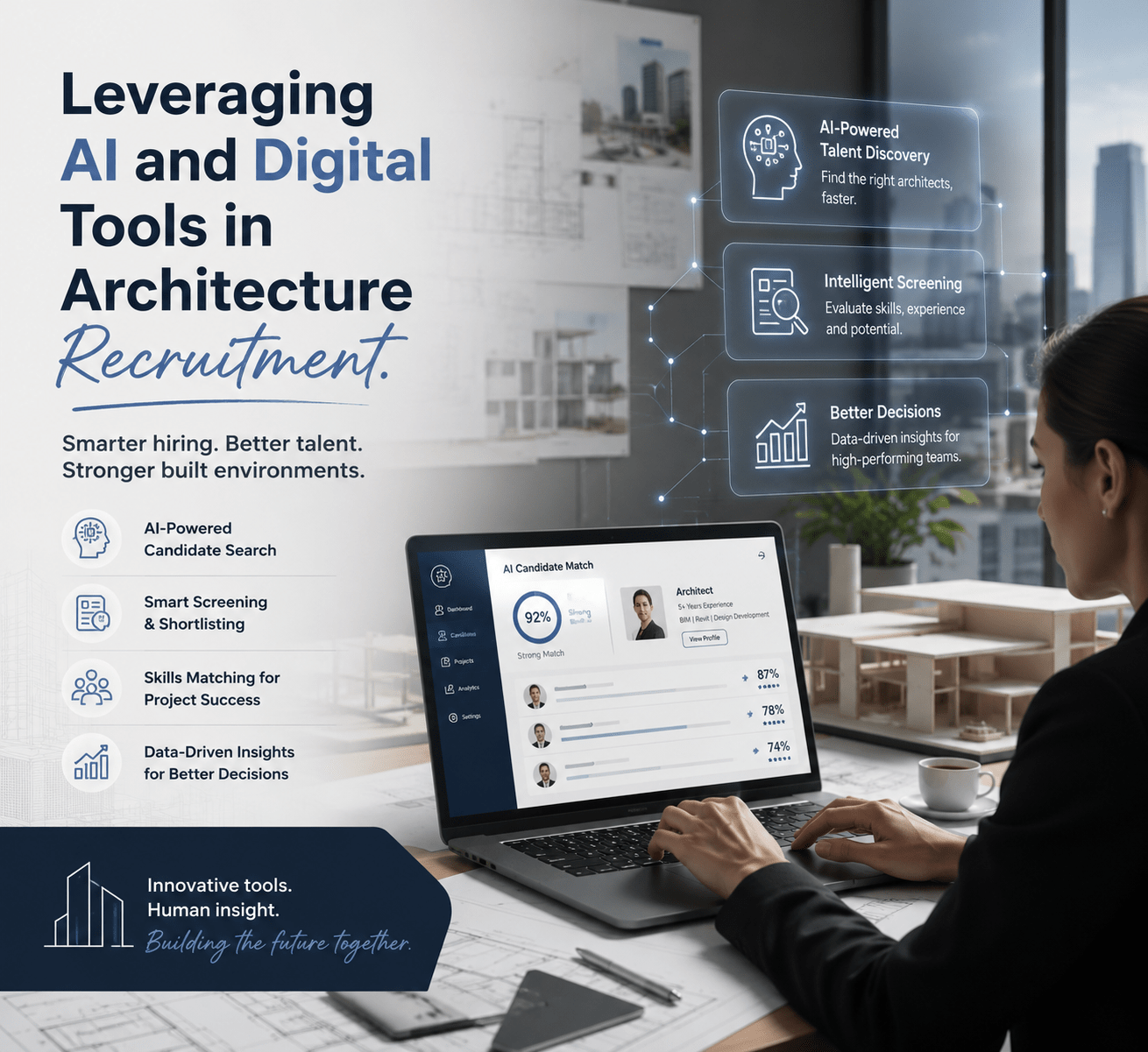
As the leader of an architecture recruitment firm, I see the challenges firms face with hiring the right talent in the current market. Modern AI-driven and digital tools are one way firms can address this issue, helping them to broaden their talent pool and hire more efficiently. Here is my advice as a recruiting expert for hiring architecture professionals with AI the right way.
How AI is changing architecture recruitment
AI recruiting tools are changing how organizations connect with talent across sectors, and architecture talent acquisition is no exception. There are three main areas where digital tools in recruitment are having a noticeable impact on architecture hiring today: sourcing, screening, and predictive insights.
AI-powered candidate sourcing
In architecture recruitment, AI is often used to help locate professionals with very specific expertise. With advanced sourcing tools, recruiters can go beyond active job seekers and find passive candidates whose experience aligns well with what firms are looking for.
Modern architecture recruitment technology goes beyond the keyword matching that these tools relied on in the past. Today, these platforms can assess professionals on a wide range of factors, from their software proficiency and licensure status to location, leadership experience, and the types of projects they work on. That’s not only useful when you’re actively hiring architects, but also allows firms to build candidate pipelines aligned to their studio culture and the technical demands of their projects.
Along with better passive candidate sourcing, AI sourcing tools can help architecture firms hire faster because they reduce the manual effort required to identify qualified architectural designers, BIM professionals, and similar skilled talent. Faster sourcing can be particularly useful in architecture, where firms often experience quick fluctuations in their workforce needs.
Resume screening and skills matching
Architecture recruitment is highly portfolio-driven. Combined with the multidisciplinary nature of the industry, this can mean conventional screening approaches struggle to evaluate candidates effectively. The AI tools for talent acquisition in architecture today go beyond analyzing resumes. They can also evaluate project histories, design specializations, and portfolio descriptions, allowing them to more accurately identify top talent for specialized roles like architectural technologists or sustainable design talent.
Using AI to hire architects also improves consistency across the hiring process and can achieve better alignment between candidates and project teams. Candidate screening software standardizes criteria across the entire talent pool, reducing inconsistencies that arise out of multiple hiring managers using different evaluation standards. Matching models that incorporate factors like client-facing experience, leadership capabilities, and collaboration history can also help firms evaluate how candidates will fit within the existing studio team.
Predictive hiring analytics
In addition to improving active, current searches, AI can be useful in long-term workforce planning for architecture firms. Analytics tools can help firms anticipate future hiring demands so they can proactively recruit to meet them before staffing gaps become critical. Considering the ongoing architecture labor shortages for roles like project architects and BIM professionals, the ability to anticipate hiring needs can be very valuable.
Predictive analytics can be a benefit for architecture staffing in other ways, as well. These systems can identify patterns that predict long-term success, insights that can help firms improve retention of high-value talent. They’re equally useful for identifying emerging leaders within a firm and can help with talent pipeline development for firms facing succession challenges as project leaders near retirement age.
What are the best digital recruiting tools for architecture firms?
AI in recruitment can be a powerful tool, but it’s not a magic bullet. The risk of bias means these systems need to be employed thoughtfully, and over-reliance on recruitment automation can negatively impact the candidate experience if it makes the hiring process feel too impersonal. The best approach isn’t to fully automate every hiring decision, but to use AI tools to support recruiter judgment. Practical tools for video interviewing, skill assessment, and recruitment marketing, as well as platforms like ATS and CRMs, tend to strike this balance the best.
Applicant Tracking Systems
An applicant tracking system (ATS) is a centralized tool for the full hiring process. It allows hiring teams to review resumes and portfolios, track interview stages and collect feedback all in one place. This helps maintain the consistency of evaluations across different roles, projects or offices, while also cutting down on administrative work. ATS platforms are especially useful for firms that handle a large number of applications or need to adjust staffing quickly during periods of high demand.
Recruitment CRM platforms
A recruitment candidate relationship management (CRM) platform is designed to maintain and manage long-term relationships with potential candidates. Where an ATS is used during the hiring process, a CRM focuses on nurturing passive candidates and building engagement before people apply. They are among the best AI recruiting tools for architecture firms that hire hard-to-find, specialized talent, helping them to build a stronger candidate pipeline and enabling proactive hiring for future needs or large-scale projects so you’re not relying solely on job postings and reactive hiring.
Video interviewing platforms
Asynchronous or live remote screening interviews are useful for reducing time-to-hire in architecture firms. Video interview platforms accelerate early-stage screening and reduce scheduling friction when you’re working across distributed teams or hiring from global talent pools. They’re a practical tool for firms expanding their talent search beyond their local market, enabling recruiting teams to assess candidates’ communication skills and get deeper insights into their design process without the need for travel and schedule coordination.
Skills assessment and portfolio review tools
When you’re conducting CAD and Revit recruitment, or filling other roles that require niche technical capabilities, skill tests give the most accurate insight into a candidate’s capabilities. Automated assessment platforms support skills-based hiring by providing real-time proof of an applicant’s technical competency. Portfolio review tools provide structure and consistency to the evaluation process, helping to ensure your hiring process is fair by applying the same criteria across the entire applicant pool.
Recruitment marketing and employer branding tools
Architecture professionals are design-sensitive and can be highly selective, which makes employer branding key for firms to attract the right talent. AI-driven marketing and branding tools go beyond just managing your job ads and content, with features to optimize your messaging and help you target the right audience for it. When used effectively, they reinforce your firm’s identity in the architecture community, which improves the quality of applications you receive and supports better long-term pipeline building.
Best practices for successfully integrating AI into recruitment
Digital transformation in architecture recruitment doesn’t need to happen all at once. In fact, it’s often better to gradually introduce new tools, giving your team time to fully learn each. The best approach for improving architecture hiring processes with AI is often to start by identifying where your current process is inefficient or breaking down. Then, choose a specific tool to address that pain point. If you frequently face delays and difficulty sourcing niche talent, for instance, then a tool focused on AI-powered candidate sourcing for architecture firms is going to address your most urgent need better than a CRM or portfolio evaluation platform.
Once you’ve picked your tool, proper training is critical to ensure HR teams and hiring leaders understand the workflow, features, and functionality of the system. Training should include insights into how AI interprets candidate data, how to limit over-filtering, and how to integrate AI insights into real-world decision making.
You also don’t want to assume that the tool is functioning effectively without proof. Instead, schedule regular audits to assess the quality and fairness of AI-assisted hiring. It’s useful to monitor indicators like retention rates of new hires, diversity in your applicant pool and the accuracy of AI-driven skill matching. If inconsistencies appear, adjust the model or hiring workflow accordingly.
No matter which tools you adopt, AI should be seen as a support for human decision-making rather than a replacement for it. Because architecture is a creative and subjective field, AI on its own can’t fully evaluate candidates. The best results tend to come from blending automation and data insights with human expertise. When AI is used to rank candidates, it’s essential that recruiters review those recommendations to ensure strong, unconventional applicants aren’t missed. Human oversight also helps maintain a more personal candidate experience and avoids the risks of an overly automated process.
FAQ
How can AI improve architecture recruitment?
AI can help firms identify qualified candidates faster, streamline administrative tasks, and make more informed hiring decisions. In a practical sense, these systems can automate repetitive tasks like screening resumes and interview scheduling. AI-powered tools are also useful for building talent pipelines that allow you to quickly meet changing staffing demands, and can help firms evaluate candidates’ technical expertise, licensure status, and project experience, allowing HR and studio leaders to focus on more nuanced aspects like evaluating design quality and team fit.
What recruitment technology should architecture firms invest in?
Most firms rely on a core set of tools such as an ATS for managing the hiring process, CRM systems for maintaining long-term candidate pipelines and portfolio review platforms that help structure the evaluation of design work. Those looking for more advanced capabilities may also invest in AI-driven sourcing tools or recruitment marketing software. The ideal tech stack varies based on the firm’s size, focus, and overall hiring volume.
What are the best tools for remote hiring and hybrid work recruitment?
Remote architecture recruiting relies heavily on tools that improve communication and make candidate evaluation easier across distributed teams. Video interviewing software is a foundational tool for conducting efficient interviews with candidates in different locations. At the same time, collaborative portfolio review platforms help hiring teams and project leaders evaluate work together in real time. For firms competing beyond their local area, recruitment CRM systems play a key role in maintaining ongoing relationships with candidates in wider talent markets.
Can AI help reduce bias in architecture hiring decisions?
When implemented carefully, AI can help reduce certain forms of bias. However, it should not be viewed as a fully objective solution. AI systems standardize portions of the screening process, which reduces inconsistencies from having multiple hiring team members review resumes or portfolios. Unfortunately, AI systems can also inherit and reinforce bias from historical hiring data if firms aren’t careful about how they’re trained and monitored. Firms should regularly audit AI-assisted hiring outcomes and use these tools to support rather than replace inclusive hiring practices.
What metrics can firms use to measure whether AI is improving hiring quality?
Recruitment efficiency is commonly measured using metrics like time-to-hire, cost-per-hire, candidate response rates and interview-to-offer ratios. Longer-term success can be assessed through indicators like employee retention, promotion rates and project performance. Comparing AI-supported hiring results with historical performance data helps organizations understand whether new recruitment technologies are delivering real improvements.